
Designing Buildings for Hotter Summers: How Architecture Can Help Keep Buildings Cool
Recent heatwaves across the UK and Europe have highlighted a growing challenge for homeowners, developers and designers alike. As our climate changes, hotter summers are expected to become more frequent, making it increasingly important to design buildings that remain comfortable without relying heavily on air conditioning.
At Croft Architecture, we believe that good design starts with understanding how a building responds to its environment. By considering cooling strategies from the outset, it is possible to create homes that are more comfortable, healthier and more energy efficient.
Start with the Building Fabric
One of the most effective ways to keep a building cool is to prevent heat from entering in the first place.
High-quality insulation, airtight construction and well-designed glazing help regulate internal temperatures throughout the year. While many people associate insulation with winter warmth, it also plays a vital role in reducing overheating during summer months.
Natural, bio-based insulation materials can provide excellent thermal performance while reducing the environmental impact of construction.
Use Thermal Mass Wisely
Materials such as stone, rammed earth, hempcrete and other dense natural materials can absorb heat during the day and release it slowly as temperatures fall.
This helps reduce temperature swings and creates a more stable internal environment.
Traditionally, concrete has often been used for thermal mass, but lower-carbon alternatives are becoming increasingly attractive for environmentally conscious projects.
Design for Natural Ventilation
Good ventilation is essential for removing unwanted heat from a building.
By carefully positioning windows, rooflights and high-level openings, warm air can escape naturally while cooler air is drawn through the building. This passive approach can significantly improve comfort during warm weather without increasing energy consumption.
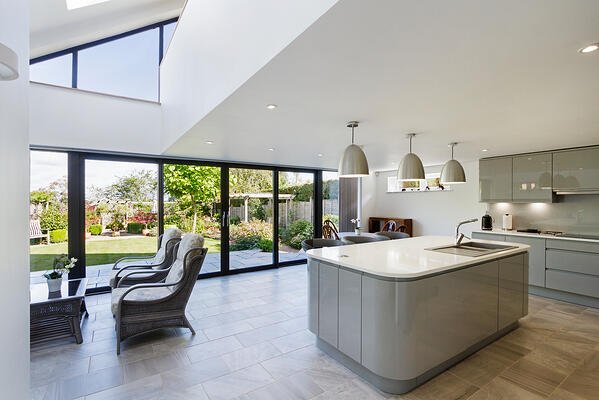
Open-plan spaces, double-height areas and vaulted ceilings can also help hot air rise away from occupied spaces.
Keep the Sun Out
Solar gain through glazing is one of the biggest causes of overheating in modern homes.
External shading devices such as overhangs, brise soleil systems, shutters and pergolas can dramatically reduce heat entering a building. Unlike internal blinds, external shading prevents the sun's energy from reaching the glass in the first place.
The orientation of a building is equally important. South-facing glazing can often benefit from horizontal shading, while east and west elevations may require vertical screening to protect against lower morning and evening sun.
Plant More Trees
Landscaping plays a major role in thermal comfort.
Trees provide natural shade and can help cool surrounding air temperatures through evapotranspiration. Deciduous trees are particularly useful because they provide shade during summer while allowing sunlight through in winter.
Green roofs, planted areas and increased biodiversity can all contribute to a cooler and more pleasant environment around a building.
Think Beyond the Building
Overheating is not just a building issue; it is also an urban design issue.
Hard surfaces such as tarmac, paving and dark roofing materials absorb and store heat, creating what is known as the "urban heat island effect". This can make built-up areas significantly warmer than surrounding countryside.
Introducing more planting, reducing unnecessary hard surfaces and selecting lighter-coloured materials can help reduce this effect and create more comfortable outdoor spaces.
Consider Renewable Technologies
Ground source heat pumps are often associated with heating, but they can also contribute to cooling strategies by taking advantage of the relatively stable temperatures found below ground.
When combined with a well-designed building fabric, renewable technologies can support year-round comfort while reducing operational energy use.
Future-Proofing Homes Through Design
Creating buildings that remain comfortable during hotter summers does not necessarily require expensive technology. In many cases, the most effective solutions are passive design principles that have been used successfully for generations.
Careful orientation, natural ventilation, thermal mass, shading, landscaping and high-performance building fabric all work together to create healthier, more resilient buildings.
As temperatures continue to rise, designing for comfort, energy efficiency and sustainability will become increasingly important for both new homes and renovation projects.
If you're planning a new home, extension, barn conversion or development project, our team would be happy to discuss how thoughtful architectural design can help future-proof your investment for years to come.
Planning a new home, extension, barn conversion or development project?
At Croft Architecture, we help homeowners, landowners and developers create sustainable, future-proof buildings across Staffordshire and the surrounding areas.
Contact our team today to arrange an initial consultation and discuss your project.
📞 Call us 01785 248542 and 01625 830572
📧 Email us enquiries@croftarchitecture.com
MORE NEWS
Extension to Victorian Property Featured In Real Homes Magazine
READ MORE
Sustainable New Build Wins Local Authority Building Control Award
READ MORE
Croft Featured In Homebuilding & Renovating Magazine
READ MORE
SEE OUR WORK
START YOUR PROJECT
